The GEO Content Audit: A 7-Step Framework to Get Cited by AI Search
The GEO Content Audit: A 7-Step Framework to Get Cited by AI Search
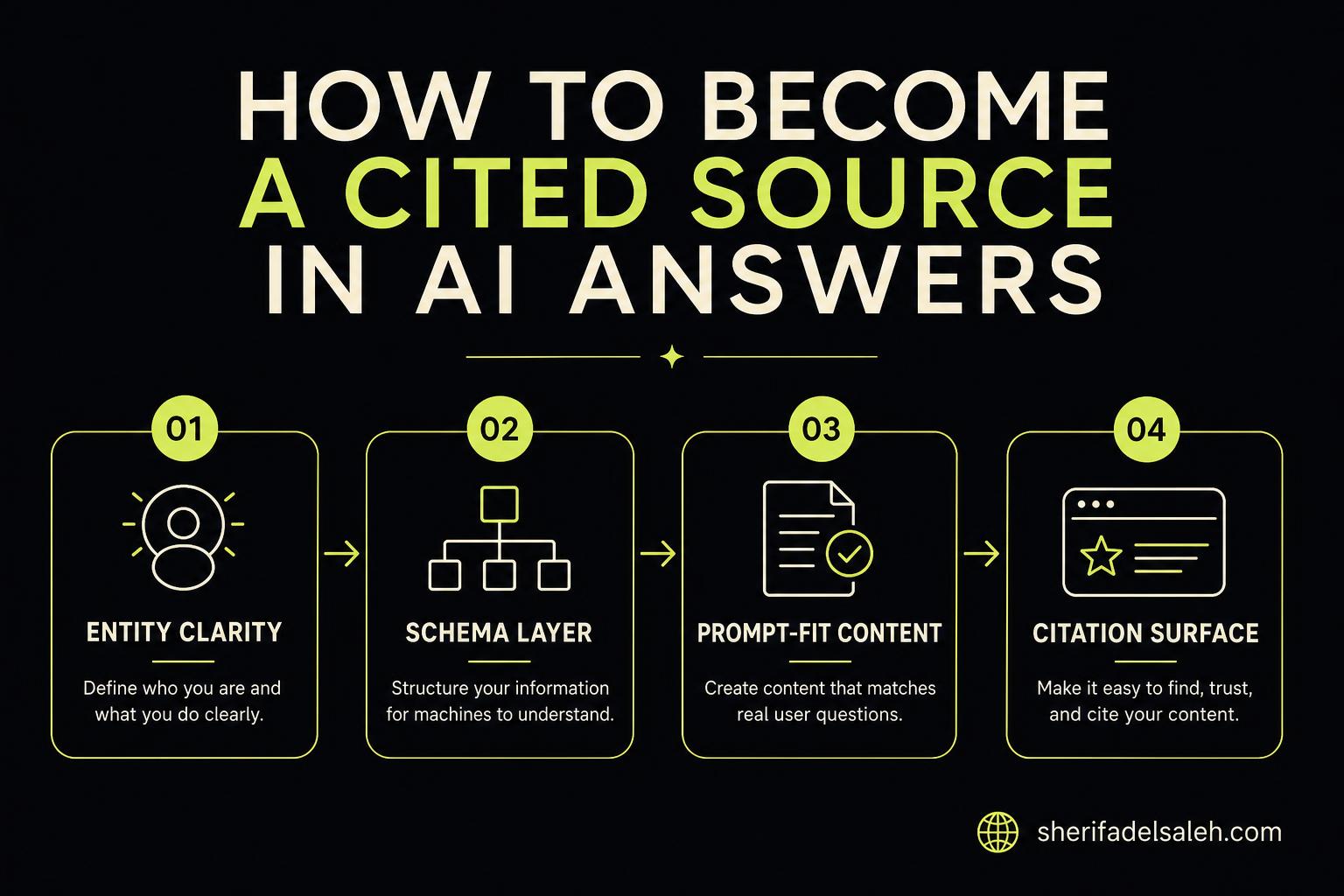
A GEO content audit answers one question: when a buyer asks an AI assistant about your category, why does it cite someone else? The answer is almost never "more content". It is usually missing entities, buried answers, weak trust signals or pages that AI crawlers cannot read. This is the seven-step audit I run before writing a single new page.
- Start with prompts, not keywords — map the questions buyers actually ask AI assistants.
- Measure your current citation share before changing anything.
- Most AI visibility gaps are structural: unreadable HTML, buried answers, missing entities.
- Fix and refresh existing pages before publishing new ones.
- Re-run the same prompt set monthly to prove impact.
Step 1 — Build a buyer prompt set
List 30–60 real questions your buyers ask across the funnel: "what is", "best tool for", "X vs Y", "how much does", "who are the top consultants for". Pull them from sales calls, support tickets, People Also Ask and Reddit threads. This prompt set becomes your fixed benchmark.
Group prompts by intent (learn, compare, buy) and by product line. You will reuse this exact set every month, so keep the wording stable.
Step 3 — Check AI crawler access
Confirm robots.txt allows GPTBot, OAI-SearchBot, ClaudeBot, PerplexityBot and Google-Extended. Then fetch key pages without JavaScript. If your main content only appears after client-side rendering, many AI crawlers see an empty page.
Server-side rendering or prerendering is the single highest-leverage technical fix for AI visibility.
Step 4 — Audit answer structure
For each priority page, check whether the first 40–60 words directly answer the main question. AI engines extract short, self-contained passages. Long introductions bury the answer and lose the citation.
Use question-based H2s, short paragraphs, comparison tables and numbered steps. Each section should make sense if quoted alone.
Step 5 — Audit entities and schema
AI systems resolve brands as entities. Check that your Organization and Person schema is consistent, that sameAs links point to LinkedIn, Crunchbase and Wikidata where possible, and that your brand name, category and location are written the same way everywhere.
Add Article, FAQ and HowTo schema where the content genuinely matches. See schema markup that wins AI citations.
Step 6 — Audit trust and evidence
Engines prefer sources with named authors, credentials, dates, original data and outbound references. Pages without an author, without a "last updated" date or without numbers are rarely cited.
Add author bios, cite primary sources, and publish at least one original data point per key page — a benchmark, a survey result or anonymised client results.
Step 7 — Prioritise and re-measure
Score each gap by impact and effort. Typical order: crawler access, answer-first rewrites of top pages, entity cleanup, trust signals, then new content for prompts where no page exists.
Re-run the prompt set 30 days after changes. A well-executed audit usually moves citation share within one to two months.
Keep reading
Answer Engine Optimization (AEO): The Complete 2026 Guide
AEO is the discipline of owning the answer — featured snippets, People Also Ask, Google AI Overviews and direct LLM citations. Here is how to win all of them.
Entity SEO: The Foundation of AI Search Visibility in 2026
Generative engines reason about entities, not keywords. Entity SEO is the work that makes a brand machine-recognizable across every AI engine.
LLM Optimization: How to Get Recommended by GPT, Claude & Gemini
LLM Optimization is the discipline of being named inside large language models. Training-data presence, entity disambiguation, schema and prompt-fit content — the full playbook.