The Schema Markup Stack That Wins AI Citations in 2026
The Schema Markup Stack That Wins AI Citations in 2026

Schema is the most under-used asset in modern SEO and the single most under-used asset in GEO. After running structured-data audits on more than 40 sites in the last 18 months, I am convinced the gap between sites that get cited in AI answers and sites that do not is, more often than not, a schema gap. This is the stack I deploy on every B2B client — and the order in which I deploy it.
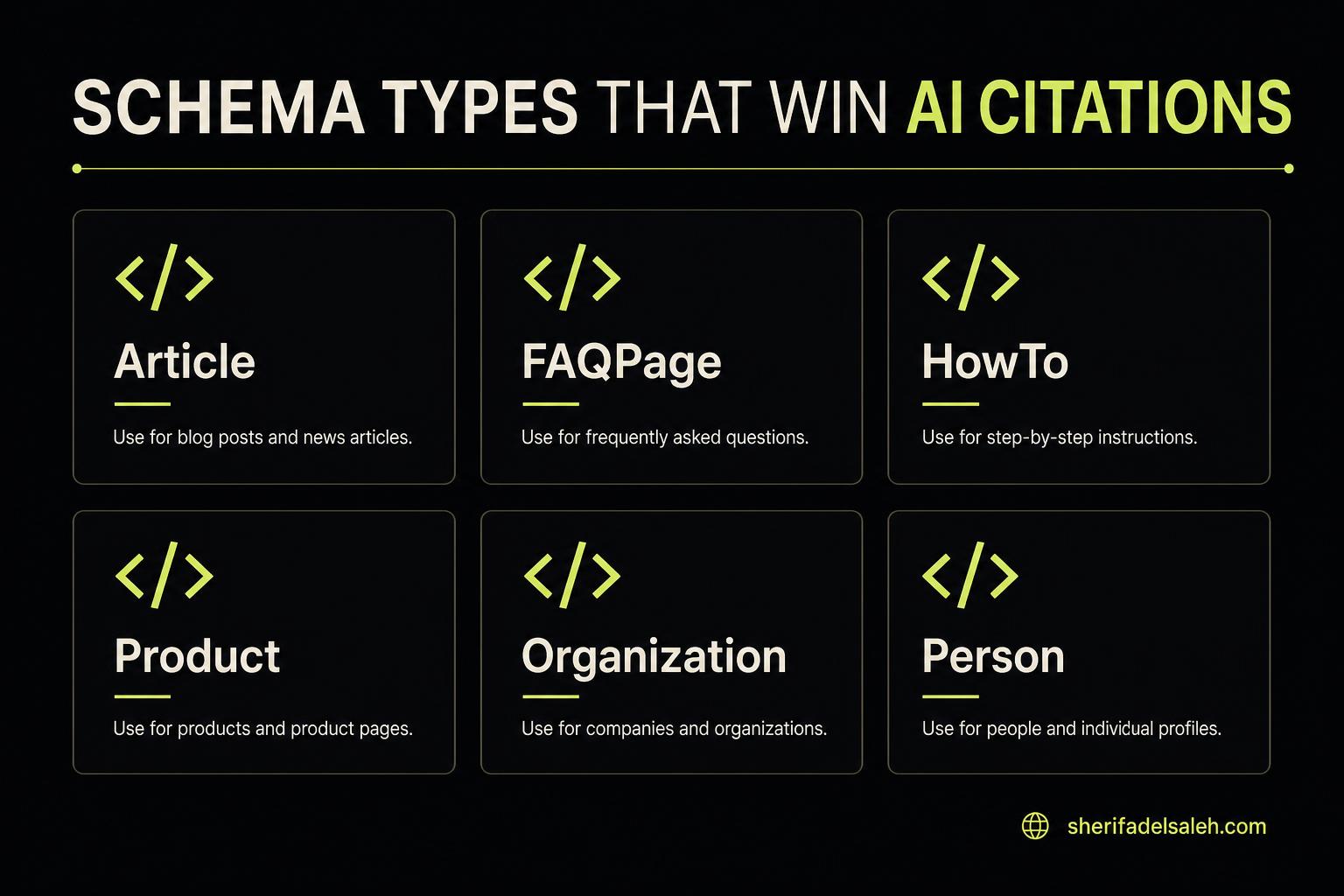
- Article, FAQPage, HowTo, Product, Organization and Person are the six schemas every site should ship.
- FAQPage and HowTo earn the most direct citations in AI Overviews — write the answer first, then mark it up.
- Organization and Person schema with sameAs are how you confirm you are a real entity to generative engines.
- Validate with Google Rich Results Test and Schema.org validator — broken schema is worse than no schema.
- Schema is the API generative engines read. Until you ship it, you are invisible to half the discovery surface.
Why schema matters more than ever
Generative engines do not have time to infer what your page is about. They parse structured data first, then read the prose to confirm. Pages with valid, matching schema are dramatically more likely to be selected as a source — in client tests, 3–5× more likely for FAQ-style queries.
The bar is also higher than it used to be. Schema must match the visible content. Mismatched FAQ schema (questions in markup that are not on the page) gets demoted, sometimes manually penalised. Ship schema honestly or do not ship it at all.
Article — the workhorse of every blog post
Every long-form post needs Article (or BlogPosting) schema with: headline, datePublished, dateModified, author (Person), publisher (Organization with logo), image (multiple sizes), mainEntityOfPage, articleSection, wordCount, inLanguage, and keywords.
The two fields most teams skip — datePublished and dateModified — are exactly the two AI engines weight most heavily for freshness. Ship them, and update dateModified honestly each time you revise the post.
"You cannot be cited as a source if you have not declared what kind of source you are. Schema is the declaration."
FAQPage — the citation magnet
FAQPage schema is the single highest-leverage block in your stack. AI engines lift FAQ entries directly into answer summaries because they are pre-formatted as Q&A.
Build them on every long-form post. Phrase the questions exactly as a real buyer would ask them ("How do I…", "What is the difference between…", "Is X better than Y for…"). Keep answers tight (40–80 words) and lift-able as a single sentence.
Validation note: every Question in your schema must be visible on the page in the same wording. Otherwise Google flags it.
HowTo — for any process content
If your page describes a process — "how to migrate from Shopify to BigCommerce", "how to set up GA4 for a SaaS", "how to onboard a B2B fintech customer" — it needs HowTo schema with named steps.
Each step gets a name, text, and (ideally) an image. AI Overviews surfaces HowTo content as numbered cards. ChatGPT lifts the step list into structured answers. Pages without HowTo schema on procedural queries get skipped in favour of pages that have it.
Product, Organization, Person — the entity layer
Product schema (with offers, aggregateRating, brand) is required for any commerce or SaaS product page if you want to be surfaced in product comparison answers.
Organization schema with sameAs links to your LinkedIn, Crunchbase, Wikidata, GitHub and X profiles is how you confirm to generative engines that you are a real, traceable entity. Without it, you are a string of characters; with it, you are a known node in the knowledge graph — see client implementations where this single fix moved citation share inside 60 days.
Person schema with sameAs is the same idea applied to authors. In 2026, an article authored by an unidentified person is meaningfully less likely to be cited than the same article authored by a verified Person entity.
How do you validate schema before shipping?
Three tools, in order: Schema.org validator (catches structural errors), Google Rich Results Test (catches enhancement-eligibility issues), and a manual spot check in Search Console > Enhancements after deploy.
Re-validate quarterly. Schema specs evolve, Google's eligibility rules tighten, and a markup that earned rich results last year may quietly stop earning them this year. Quarterly cadence catches the drift before it costs you traffic — or book a 14-day audit and I will deploy the full stack for you.
Keep reading
Answer Engine Optimization (AEO): The Complete 2026 Guide
AEO is the discipline of owning the answer — featured snippets, People Also Ask, Google AI Overviews and direct LLM citations. Here is how to win all of them.
Entity SEO: The Foundation of AI Search Visibility in 2026
Generative engines reason about entities, not keywords. Entity SEO is the work that makes a brand machine-recognizable across every AI engine.
LLM Optimization: How to Get Recommended by GPT, Claude & Gemini
LLM Optimization is the discipline of being named inside large language models. Training-data presence, entity disambiguation, schema and prompt-fit content — the full playbook.