How to Measure AIO & GEO Performance: The Three Metrics That Actually Matter
How to Measure AIO & GEO Performance: The Three Metrics That Actually Matter

The most common GEO question I get from CMOs in 2026 is the same one: "We are doing the work — but how do we prove it?" Rank trackers do not see ChatGPT. Google Analytics does not natively show AI Overview citations. The standard SEO dashboard is blind to half the discovery surface buyers now use. Here is the three-metric system I deploy with B2B clients to make GEO and AIO performance legible to a board.
- Three metrics replace the rank-tracker mindset: Citation Index, Generative Referrals, Branded Query Volume.
- Citation Index — your share of cited sources across a fixed prompt set, tracked weekly.
- Generative Referrals — sessions arriving with referrer chat.openai.com, perplexity.ai, gemini.google.com and similar.
- Branded Query Volume — the leading indicator that AI exposure is creating real demand.
- Together these triangulate the impact rank trackers cannot see — and they are board-presentable inside one quarter.
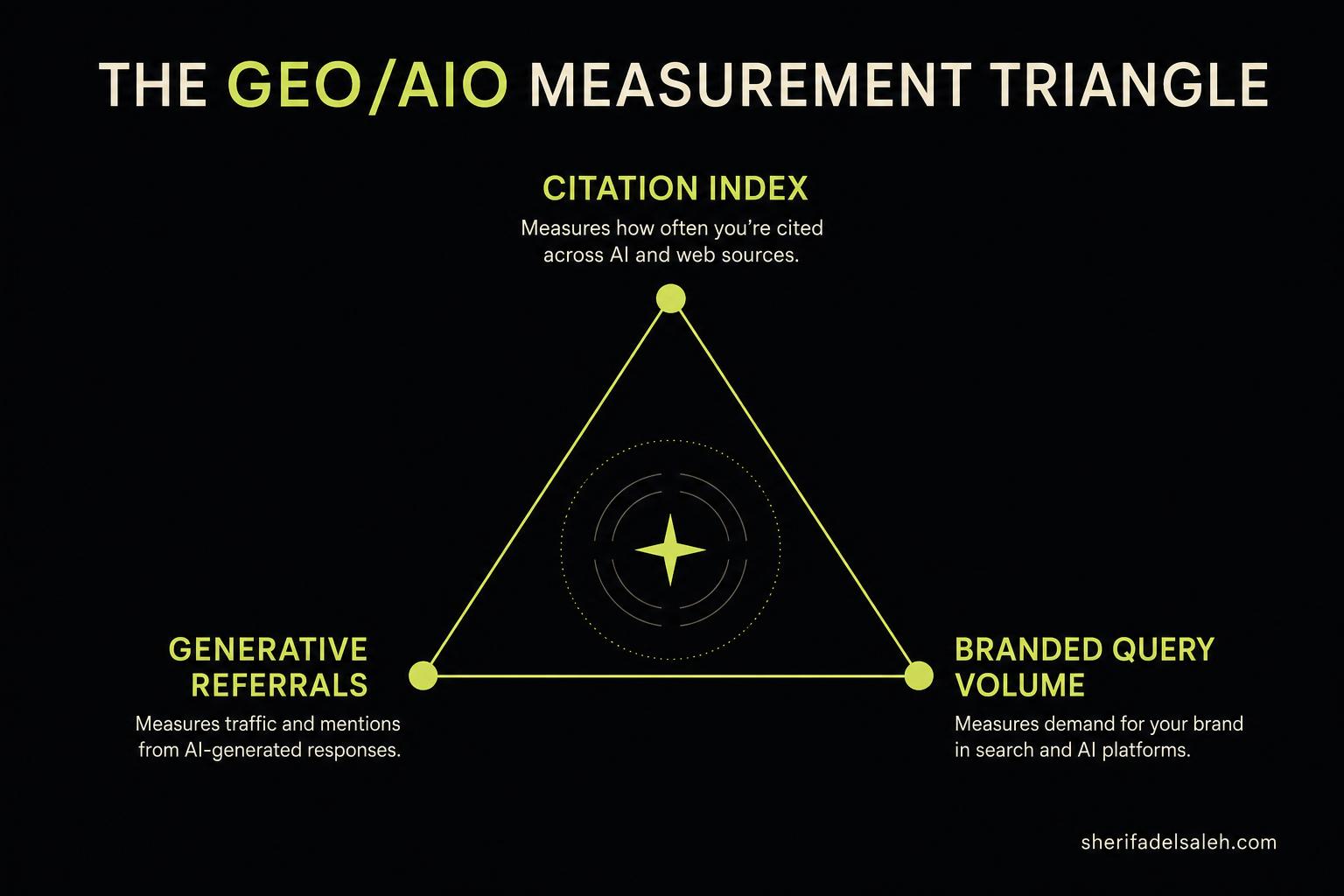
The measurement triangle
GEO and AIO performance triangulate from three independent metrics. Each one alone is noisy. Together they form a defensible story: are you being cited (citation index), is that translating into traffic (generative referrals), and is that creating real demand (branded query volume)?
When all three move up together, the program is working. When citations move up but referrals do not, your snippet positioning needs work. When referrals move up but branded queries do not, you are getting traffic but not memory — adjust the messaging to be more brand-forward.
Metric 1 — Citation Index
Define a fixed prompt set — 30–50 prompts a real buyer would ask in your category, including direct competitor comparison prompts. Once a week, run that prompt set through ChatGPT, Perplexity and Google AI Overviews and record which sources are cited in the answer.
Your citation index is your share of citations across the set. A baseline of 5–10% is normal at week one. A healthy 90-day target is 20–30%. Above 40% means you have become the default reference in your category — which usually translates into a step-change in inbound demand.
Tools: tools like Profound, Otterly.ai, AthenaHQ and Peec AI automate this; a Google Sheet plus a weekly hour of manual checking works just as well at small scale.
"You cannot manage what you do not measure. GEO requires new metrics — old dashboards make you look like you are losing while you are winning."
Metric 2 — Generative Referrals
Generative referrals are sessions where the referring host is a known generative surface: chat.openai.com, perplexity.ai, gemini.google.com, copilot.microsoft.com, claude.ai, you.com.
Filter your analytics for those referrers and create a saved segment. In 2025 client data this segment averaged 0.8% of sessions. By Q1 2026 it is 4–9% across the same accounts. By 2027 most B2B forecasts put it above 15%. The brands that start tracking now have two years of comparable data when those sessions become a major share of total traffic — see recent client benchmarks.
Critical detail: generative referrals convert dramatically better than blended traffic. In client data they convert at 3–6× the site average — because the user already pre-qualified themselves through an AI conversation before clicking through.
Metric 3 — Branded Query Volume
When you start being cited in AI answers, buyers hear about you in conversation and then search to verify — usually with branded or near-branded queries ("[your brand] reviews", "[your brand] vs [competitor]", "is [your brand] legit").
Pull a weekly Search Console export and trend "Queries containing [brand]" over time. A consistent week-over-week lift here is the highest-fidelity proof that your AI exposure is creating real, persistent demand — not just one-off clicks.
I treat branded query volume as the lagging indicator that confirms the leading indicator (citation index) is real. When both move together, the story tells itself.
Putting it in front of a board
Build a one-page monthly report with three charts side by side: citation index trend (with named competitor lines), generative referrals as a % of total sessions (with absolute count), and branded query volume (Search Console export).
Below the charts, a four-line narrative: what moved, why it moved, what we are doing next month, what we expect to see. That report has won me more SEO/GEO budget renewals than every dashboard in Looker put together. Boards fund stories backed by trended numbers, not dashboards full of metrics they cannot interpret. If you want this report installed for your team, book a measurement audit or see how I work.
How long until the metrics show meaningful movement?
Generative referrals show movement first — usually within 2–4 weeks of shipping a strong schema and prompt-fit content pass. Citation index moves in weeks 4–8 as engines re-index and re-weight you. Branded query volume is the slowest to move — typically 8–16 weeks — because it requires real human conversations to compound.
Set the expectation early. Boards lose patience with marketing programmes when month one shows no movement on the lagging indicator. Show the three trends together and the story is always defensible.
Keep reading
From Dashboard to Decision: How I Run a Weekly Marketing P&L Review
Most marketing teams have dashboards. Few have decisions. Here is the 60-minute weekly ritual I use to turn GA4, HubSpot, and Stripe data into board-ready calls on budget, channels, and pipeline.
From Dashboards to Decisions: A Marketing Analytics Framework
Most marketing teams drown in data and starve for insight. Here is how to build an analytics stack that drives action, not just reports.
2026 SEO Playbook: What Moves Rankings Now
Master 2026 SEO: Focus on intent, technical excellence, topical authority, and AI optimization for sustainable ranking growth.