From Rankings to Revenue: The 2026 SEO Pipeline That Actually Funds Itself
From Rankings to Revenue: The 2026 SEO Pipeline That Actually Funds Itself

Every CMO has had the same conversation. Marketing reports a +180% lift in organic traffic. Finance asks how much revenue that produced. Marketing pauses. The room gets quiet. Then someone changes the subject. The reason this happens — even with great rankings — is that almost nobody ships a complete SEO pipeline. Traffic is shipped, but the funnel from impression to revenue is broken at three predictable joints. Here is how to fix it.
- A real SEO pipeline tracks five stages — impressions → clicks → sessions → MQLs → revenue.
- Most programmes break at the click-to-session joint (intent mismatch) and the session-to-MQL joint (no conversion path).
- A 1,000,000-impression month with a 0.02% impression-to-revenue rate beats 5M impressions at 0.001% — focus on conversion, not volume.
- Tie every page to a revenue stage. If a page does not progress one, kill it or merge it.
- Report SEO in revenue terms. The number is calculable; the only reason it is not reported is no one has built the pipeline.
The pipeline, end to end
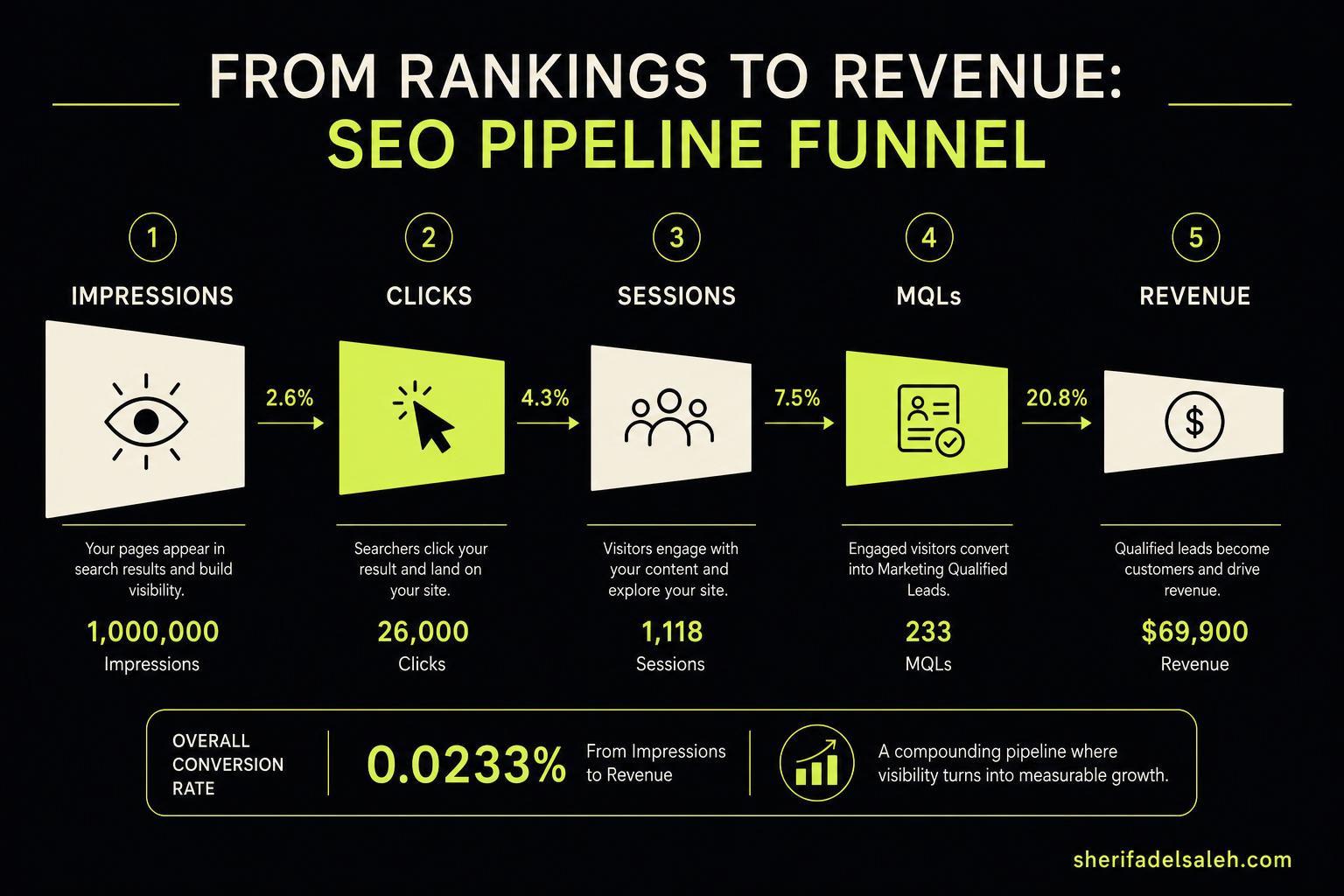
A complete SEO pipeline has five stages and four conversion rates between them. Impressions become clicks (CTR). Clicks become sessions (after bot filtering and bounce). Sessions become MQLs (after a meaningful engagement event). MQLs become revenue (after sales close rate × average contract value).
When you draw the pipeline this way, the bottleneck is almost never "we need more traffic". It is one of the four conversion rates between stages. Fix the worst one first.
Joint 1 — Impressions to clicks (CTR)
A 2.6% blended CTR is healthy in 2026 — well below the 4–5% of three years ago because of AI Overviews compression. If you are below 1.5%, the title and meta are wrong, the SERP intent is wrong, or you are ranking on the wrong page type for the query.
Quick fix: open Search Console, sort by impressions descending, filter for queries where CTR is more than 1 standard deviation below your blended average. Rewrite those titles to match the dominant SERP angle, not yours. Most teams pick up 15–25% more clicks in 30 days from this single pass.
"Traffic without a pipeline is theatre. The funnel is the entire job."
Joint 2 — Clicks to sessions (intent match)
If your bounce rate above 75% on top organic landing pages, you have an intent mismatch. The visitor clicked because the snippet promised one thing; the page delivered another. This is the single most expensive joint in the pipeline because you have already paid for the click via opportunity cost.
Fix: rebuild the top 20 landing pages so the H1 and the first 100 words mirror the query and the snippet exactly. Promise → deliver in the first scroll. Bounce on those pages typically drops 20–40 points within two weeks of the rebuild.
Joint 3 — Sessions to MQLs (the conversion surface)
A session that does not have a clear, low-friction conversion event on it is wasted spend — you paid an opportunity cost to acquire a visitor, then never asked them to act. The B2B benchmark I work to is 7–9% of organic sessions firing at least one meaningful conversion event (demo request, content download, calculator use, contact form, signup).
Concretely: every long-form article needs an inline content-to-lead capture (not just a footer CTA), every comparison page needs a demo CTA above the fold, and every solution page needs a calculator or simulator. Sites that do this convert 3–5× the sites that hide the CTA in the nav.
Joint 4 — MQLs to revenue (sales-marketing alignment)
This is where most marketing teams stop measuring. They report MQLs and hand off. But the close rate of organic MQLs varies wildly by page — buyers who landed on a top-of-funnel guide convert at 8–12%, buyers who landed on a "vs competitor" page convert at 25–40%.
Pipe the source page into your CRM as a property on every lead. After 90 days, segment close rate by landing page. You will discover that 20% of your pages produce 80% of revenue — and the next quarter of content investment writes itself. For real-world examples of this segmentation in action, see recent client case studies.
How do you actually report SEO as revenue?
The math is not hard. Sessions × MQL conversion rate × MQL-to-customer rate × ACV = SEO revenue. Most teams have all four numbers — they have just never multiplied them in front of finance.
Build that chart. Report it monthly. Within two quarters, SEO stops being a cost centre that is justified with traffic graphs and starts being a P&L line that is funded with conviction. If you want this installed end-to-end, start with a 30-minute call or review my full approach on the homepage.
Keep reading
E-E-A-T in 2026: The Trust Signals That Actually Rank
Experience, Expertise, Authoritativeness and Trust are not a checklist — they are a signal stack. Here is how to ship them so Google and AI engines both notice.
2026 SEO Playbook: What Moves Rankings Now
Master 2026 SEO: Focus on intent, technical excellence, topical authority, and AI optimization for sustainable ranking growth.
GEO vs SEO: How to Get Cited by ChatGPT, Gemini, and Perplexity
Generative Engine Optimization is not a replacement for SEO — it is the next layer. Here is how to make AI engines pick your brand as the source.