E-E-A-T in 2026: The Trust Signals That Actually Rank
E-E-A-T in 2026: The Trust Signals That Actually Rank

Every SEO consultant talks about E-E-A-T. Almost none ship it. The reason: most teams treat E-E-A-T as a vibe — "be more trustworthy" — instead of a stack of concrete, machine-readable signals you can engineer page by page. After a year of running E-E-A-T audits across YMYL and B2B sites in three regions, this is the version that actually moves rankings and AI citations together.
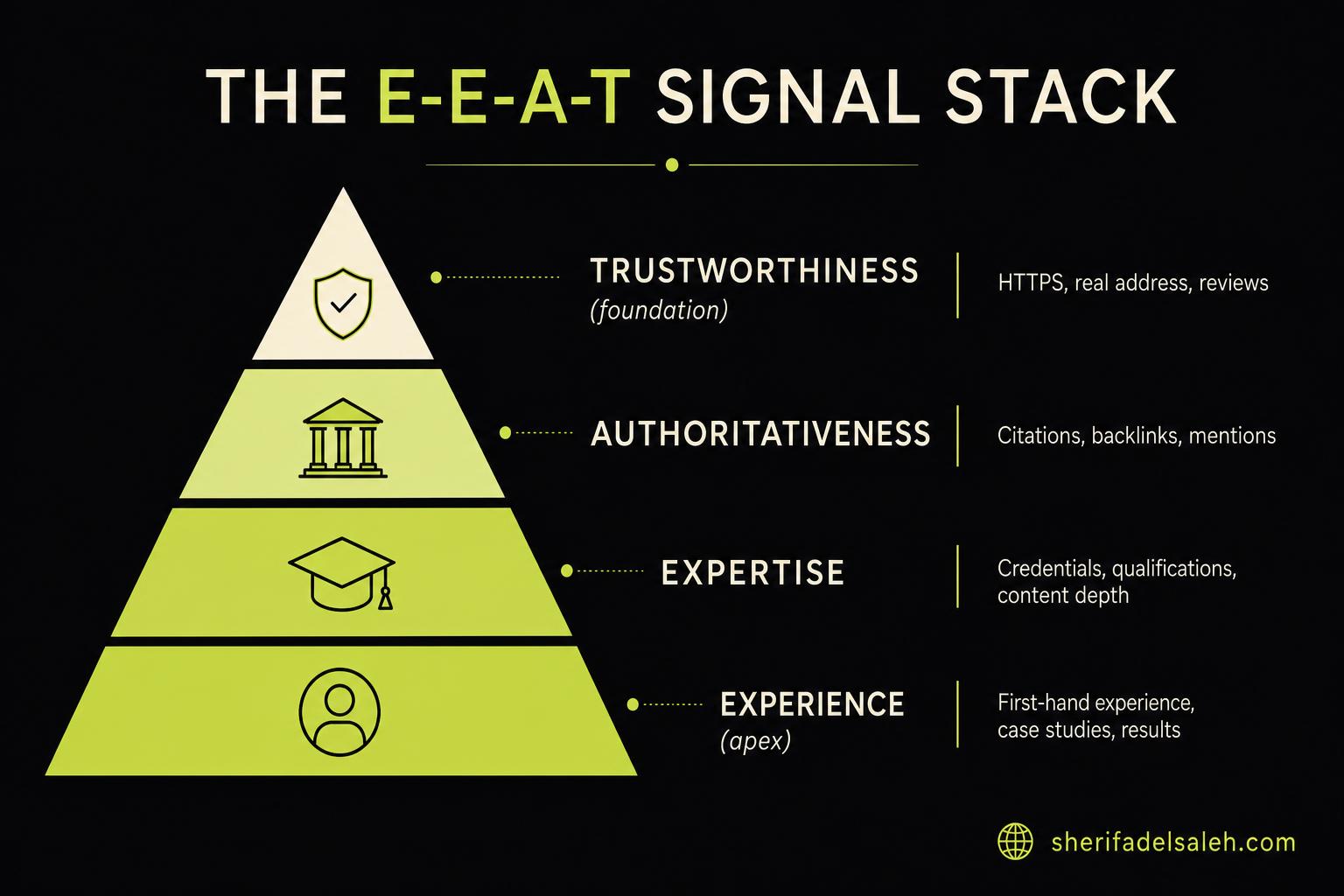
- Trust is the foundation — without HTTPS, real NAP, real reviews and real policies, nothing above matters.
- Authoritativeness is earned off-site: citations, mentions, and being named where buyers already look.
- Expertise is the credentialed depth of the author — and now the entity-graph confirmation that they are who they claim.
- Experience is the new "E" — first-hand, dated, evidenced. Screenshots, before/after data, named clients beat generic guides.
- AI engines weight E-E-A-T even more aggressively than Google — a weak stack quietly excludes you from AI Overviews and ChatGPT citations.
The signal stack, ordered
Think of E-E-A-T as a four-layer pyramid. Trust is the foundation — without it, nothing above counts. Authoritativeness is the second layer, earned off your domain. Expertise is the credentialed substance of who is writing. Experience — the newest "E", added in late 2022 and now the most heavily weighted in YMYL categories — sits at the apex.
Most teams stack this upside down. They obsess over expertise (long author bios, credential dumps) but ship pages with no HTTPS, no real address, no review schema, and no first-hand experience. Google and the AI engines see straight through it.
Trust — the floor nobody passes without
A real, verifiable address. A working phone number. Site-wide HTTPS with no mixed-content warnings. A privacy policy and terms page authored after 2023 (not lifted from a template). Review schema with real reviews — dated, named, with response history.
For YMYL categories (health, finance, legal) add: editorial policy, fact-checking policy, corrections policy, and named medical/legal/financial reviewers per article. These are now the price of admission. Ship them and you join a much smaller candidate pool — that alone moves rankings on most sites I audit.
"E-E-A-T is not a content tactic. It is a publishing posture — proven on every page or proven on none."
Expertise — the entity, not just the bio
A long author bio is not expertise. Expertise is a verifiable identity: a Person schema with sameAs to LinkedIn, Wikidata, Crunchbase, GitHub, ORCID, conference talks, and prior published work. Google can match those signals to a real person; an AI engine can confirm the entity exists across the web.
For agencies and solo operators this is the highest-leverage move of 2026: ship a real Person entity, link every article to that author with author schema, and make sure the author URL on each post resolves to a substantive bio page — not a one-line WordPress avatar block.
Experience — the new top of the stack
Experience is first-hand, dated, evidenced. A guide to onboarding fintech customers written by someone who has actually onboarded 200 of them — with screenshots, named clients (where allowed), data — outranks a generic guide written by a content writer who has never touched the product.
Concretely: every long-form article should include at least one of these proof artefacts — a real screenshot from the work, a before/after metric with the date, a named client quote, or a process artefact (a real audit template, a real tracking spreadsheet). Pages that ship at least two of these are cited in AI Overviews dramatically more often than equivalent pages without.
How does E-E-A-T affect AI engines specifically?
AI engines are downstream of E-E-A-T. ChatGPT, Perplexity and Gemini cite sources their internal trust models already approve. A site that ships every E-E-A-T signal — verified entity, dated experience, real authority signals, locked-down trust layer — passes those filters cleanly. A site that ships none gets quietly skipped, regardless of how good the prose is.
This is why the pages that win in 2026 read more like investigative journalism than blog posts. Bylined. Dated. Sourced. Evidenced. Updated. That is the publishing posture E-E-A-T requires now — book a 30-minute audit and I will score your top 10 pages against the four-layer stack.
Keep reading
From Rankings to Revenue: The 2026 SEO Pipeline That Actually Funds Itself
Ranking is a vanity metric until you tie it to pipeline. Here is the funnel I run with B2B clients to make SEO a P&L line, not a cost centre.
2026 SEO Playbook: What Moves Rankings Now
Master 2026 SEO: Focus on intent, technical excellence, topical authority, and AI optimization for sustainable ranking growth.
GEO vs SEO: How to Get Cited by ChatGPT, Gemini, and Perplexity
Generative Engine Optimization is not a replacement for SEO — it is the next layer. Here is how to make AI engines pick your brand as the source.