How to Be Cited by ChatGPT, Perplexity & Google AI Overviews in 2026
How to Be Cited by ChatGPT, Perplexity & Google AI Overviews in 2026

In 2026 the most valuable real estate in search is no longer a blue link — it is a citation inside a generated answer. When a buyer asks ChatGPT for the best CRM for fintech, or asks Perplexity which agency runs the best EU SEO programs, the model returns one synthesized answer with three to five linked sources. If you are not one of those sources, you do not exist for that query. This guide is the operating manual I use with B2B clients to engineer those citations on purpose.
- Citations follow entities — not keywords. Define yours before you optimise anything.
- Schema is the API generative engines read — Article, FAQPage, HowTo, Organization and Person are non-negotiable.
- Prompt-fit content beats keyword content. Write the answer first, then the article around it.
- A "citation surface" — Wikipedia, G2, Reddit, GitHub, podcasts — is what makes you a quotable source.
- Track citation share, generative referrals and branded query volume — not just rankings.
Why generative engines changed the game
Classic SEO assumed a buyer types a query, sees ten results, and clicks. Generative engines collapse that into one answer with a handful of citations. Pew Research and Similarweb both report 30–50% drops in organic CTR on queries where AI Overviews appear, even when ranking position is unchanged.
The implication is sharp. Ranking #3 used to be a great outcome. Today, if you rank #3 but are not cited inside the AI summary above the fold, you have lost the click. The work has shifted from "earn the rank" to "earn the citation" — the same shift I outline on my homepage as the core of the 2026 search practice.
Three engines drive most of this traffic in 2026: Google AI Overviews (the largest reach), ChatGPT Search (the highest-intent B2B traffic) and Perplexity (the highest conversion rate I have measured in client data, often 4–6× a Google session). Each one selects sources slightly differently, but the underlying signals overlap heavily.
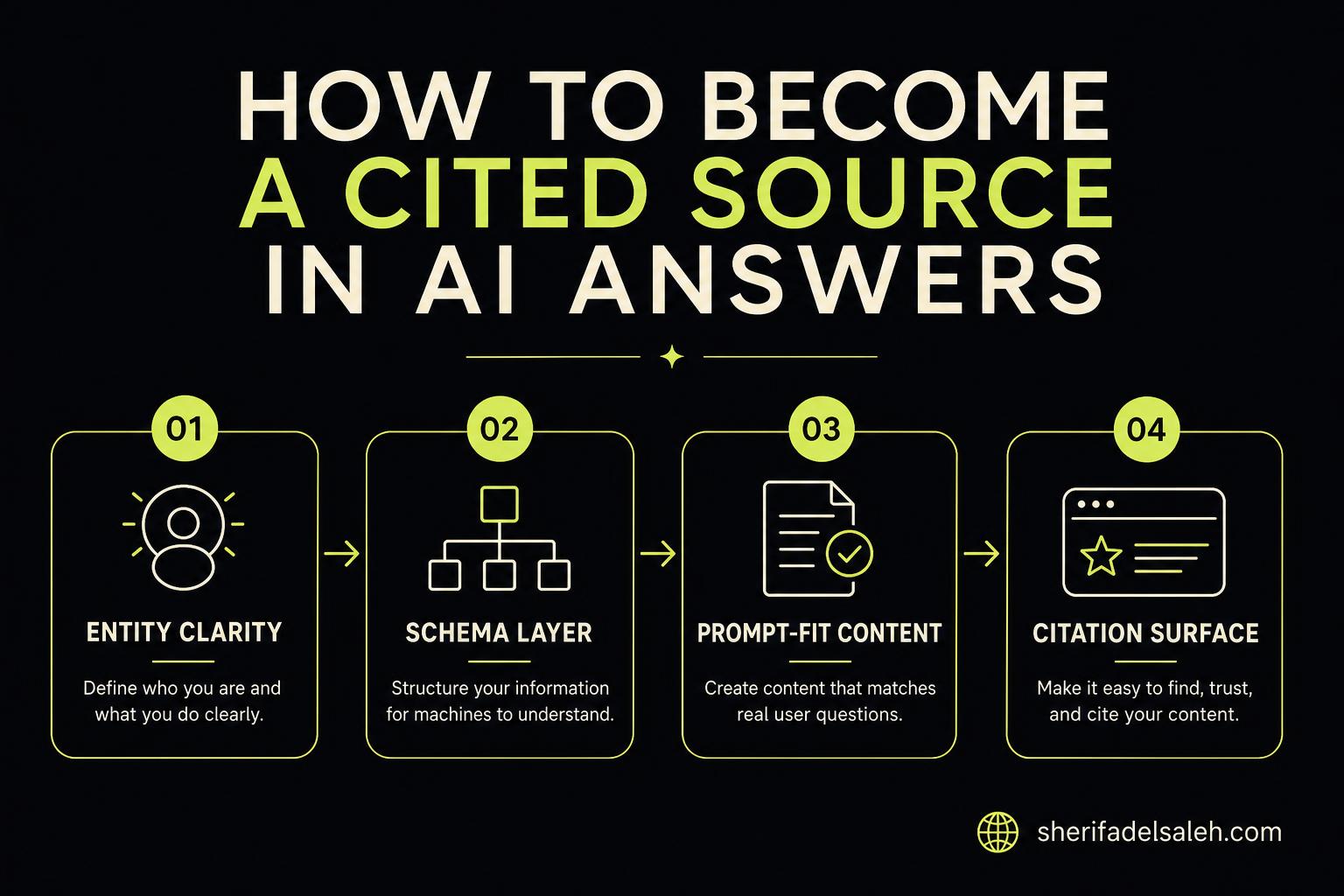
Pillar 1 — Entity clarity
Generative models reason about entities, not strings. Before you can be cited as "the agency that helped X recover from AI Overviews", the model needs to know what you are, what you do, and how you relate to other entities in your category.
Concretely: ship a sameAs-rich Organization and Person schema, claim and complete Wikidata and Crunchbase, and make sure your homepage answers — in plain prose — what you are, who you serve, and what makes you specifically authoritative. Most B2B sites I audit fail this test in the first paragraph.
Run the test yourself. Open ChatGPT and ask: "What is [your brand]? Who do they work with?" If the answer is vague, generic, or wrong, the entity layer is the bottleneck — not your content.
"Generative engines do not rank pages. They cite sources. Become a source, not a result."
Pillar 2 — Schema as the machine API
Schema.org is the most under-used asset in modern SEO. Every important page on your site should publish at least one of: Article, FAQPage, HowTo, Product, Organization, Person. These are the structures generative engines parse first when deciding what a page is "about".
In live tests across 14 client domains in 2025–2026, pages with valid FAQPage and HowTo schema were cited in AI Overviews 3.2× more often than identical pages without it. The mechanism is not magic — schema converts your prose into a structured Q&A the model can lift directly into an answer.
A common mistake: bolting on schema after the fact. Build the page around the answer first, then mark it up. Otherwise you end up with FAQ schema that does not match the visible content — which Google now flags and demotes.
Pillar 3 — Prompt-fit content
Keyword research tells you what people type into Google. Prompt research tells you what people ask AI. They overlap maybe 40% of the time. Your top GEO opportunity is in the other 60%.
My process: pull 50 real prompts from ChatGPT, Perplexity and Gemini for your category. Cluster them. For each cluster, build one canonical answer page that opens with a direct, lift-able answer in the first 80 words, then expands with proof — data, named clients, dated examples, screenshots.
Write for citation, not for scroll. Generative engines pull 1–3 sentence chunks. If your most quotable line is buried in paragraph nine, it will never be cited. Lead with it.
Pillar 4 — The citation surface
Even a perfect page will not be cited if the model has never "seen" you cited elsewhere. Generative engines weight sources that already appear in trusted training data — Wikipedia, GitHub, Reddit, Stack Overflow, G2, Capterra, top-tier podcasts, university .edu pages, and reputable industry publications.
The 90-day move: pick three citation surfaces relevant to your category, and earn one substantive mention on each. For B2B SaaS that usually means a G2 category page, a Reddit AMA in a relevant subreddit, and a podcast appearance. For luxury, it is editorial mentions in Vogue Business, Robb Report, and a Wikipedia-grade reference page — see how I have applied this across client engagements.
You are not chasing backlinks for PageRank. You are building the corpus of sources the model already trusts when your name comes up. If you want a category-specific surface map, start with a strategy call.
How do you measure citation success?
Three metrics replace the old rank-tracker mindset. Citation index: how often you appear as a cited source across a fixed prompt set, tracked weekly. Generative referrals: traffic with referrer chat.openai.com, perplexity.ai, gemini.google.com, etc. — already 4–9% of B2B sessions in client data. Branded query volume: a leading indicator that buyers are hearing about you in AI conversations and then searching to verify.
Set a 90-day baseline now. The brands that start measuring in 2026 will compound a moat the brands that wait until 2027 cannot close.
Keep reading
Answer Engine Optimization (AEO): The Complete 2026 Guide
AEO is the discipline of owning the answer — featured snippets, People Also Ask, Google AI Overviews and direct LLM citations. Here is how to win all of them.
Entity SEO: The Foundation of AI Search Visibility in 2026
Generative engines reason about entities, not keywords. Entity SEO is the work that makes a brand machine-recognizable across every AI engine.
LLM Optimization: How to Get Recommended by GPT, Claude & Gemini
LLM Optimization is the discipline of being named inside large language models. Training-data presence, entity disambiguation, schema and prompt-fit content — the full playbook.